
Kearney Directory Collections
Kearney has no single, continuous digital run. Instead, the useful shelf is split among a scanned Polk volume, institutional microfilm, genealogy-society holdings, and local-history leads. The collection inventory identifies a source without claiming every year survived. Publication dates describe when a publisher issued a volume. They do not prove where a person was on every day of that year, and a missing name can reflect omission, a variant spelling, or a different listing choice.
| Collection | Years | Where Held | Access |
|---|---|---|---|
| R. L. Polk & Co. Kearney directory | 1908-09 | NEGenWeb Buffalo County collection | Free page-addressable scan |
| Kearney directory microfilm | 1904-33 | Omaha Public Library City Directory Collection | Microfilm collection |
| Listed Kearney runs | 1917-18, 1924, 1926, 1939-40, 1947, 1950, 1952, 1956, 1958, 1960-61, 1963-66, 1968, 1971-72, 1974, 1976-85, 1989, 1993-94 | Nebraska State Genealogical Society | Holdings listing, confirm current access with the society |
| Genealogy and local-history leads | Varies by source | Kearney Public Library, City of Kearney, and Buffalo County Historical Society | Online leads, library service, or archive visit |
The gaps matter. Omaha’s 1904-33 microfilm range is not the same as a complete sequence of Kearney books available at every location. The later society list is fragmented. Record the volume year, page, original spelling, and repository before comparing names across volumes.
Note: A historical listing is useful date-and-place evidence, but it is not proof of a current Kearney address.
Kearney Directories Online
The 1908-09 R. L. Polk & Co. volume is the clearest online starting point because its alphabetical names, street section, classified pages, abbreviations, and civic material are separated into readable pages. The name section occupies pages 27 through 136, while the street directory occupies pages 137 through 156. Search a surname, preserve the printed entry, and then turn to the street section for the address context. The classification pages and advertisements can add a dated view of nearby institutions without turning a historical name into a present-day claim.
The City of Kearney’s Genealogy Resources route points researchers toward local and state repositories that can corroborate a directory lead.

Use the resource list to branch from a dated directory entry to cemetery, library, archive, or vital-record material, with the custodian’s rules kept intact.
The original 1908-09 scan remains available through the NEGenWeb Kearney directory index. It is a publication snapshot. It cannot settle a same-name question on its own.
Kearney Directory Collection Gaps
Use a holding list as an inventory, not as a promise that a particular book is digitized or ready for remote viewing. Omaha Public Library identifies Kearney microfilm for 1904 through 1933. The Nebraska State Genealogical Society identifies selected later years, including 1917-18, 1924, 1926, 1939-40, and multiple runs through 1993-94. A research request can name the year sought and ask whether a readable copy, reader, reproduction option, or staff-assisted lookup is available.
Kearney Public Library’s reference desk is another useful channel for local-history questions. Its genealogy resources identify historical directory books, news access, cemetery resources, books, and licensed genealogy databases. The Buffalo County Historical Society archives at the Family History Center and Trails and Rails Museum are listed for Monday afternoons from 1 to 4 or by appointment. Those routes are especially useful when the scan and microfilm do not cover the needed year.
Do not fill a gap by silently substituting a later record. A later book can suggest a next question, but the missing year should remain visible in the research notes.
Reading Kearney Directory Entries
An entry in the Polk volume can hold more than a name and a number. It may print initials or a suffix, a spouse or other household notation in parentheses, an occupation or public role, an employer, and a residence, boarding, or rooms notation. The street section changes the view: it arranges names and businesses by address instead of alphabetically. Read both sections before drawing a conclusion about one historical household.
| Printed name | Headword, initials, suffixes, and relationship wording exactly as the volume prints them. |
|---|---|
| Household clue | Parentheses, widow or widower wording, and boarding language that may describe a relationship or living arrangement. |
| Activity or public role | Occupation, employer, civic role, or business context where the entry includes it. |
| Address notation | Street number and historical street form, with residence, boarding, or rooms notation when printed. |
| Page locator | Alphabetical or street-section page needed to revisit the original scan. |
| Ownership or occupancy mark | Use only a symbol or notation the specific volume explains; do not infer a legal interest from a name line. |
A common surname needs more than one discriminator. Compare initials, relationship notation, address, page placement, and date. A directory’s address may be a residence, boarding place, rooms, or a business connection, so it is not a substitute for a property or vital record.
Kearney Directory Shorthand
The brief marks in the 1908-09 volume change the meaning of an entry. Read the printed abbreviation list before expanding any shorthand. The scan uses r for residence or resides, b for boards, and rms same for rooms at the same address. A parenthetical name can be a spouse or another household clue, not a second independently verified address.
- Criss-cross directory
- The street-order portion of a directory, used to inspect names and businesses around an address.
- Householder index
- An arrangement centered on a household head or address context, when the volume provides one; it should be read with the alphabetical section.
- Abbreviation key
- The publisher’s printed explanation of short forms. Photograph or transcribe it before interpreting an unfamiliar mark.
- Historical street form
- The street spelling as published, such as an abbreviated avenue or ordinal form, which should be preserved before a modern search is attempted.
This notation is a Kearney-specific reading lesson, not decorative detail. For a historical address, checking the alphabetical entry and then the street section often reveals different household or business context.
Kearney Directory Timeline
The known chronology is a map of surviving access, not a claim that publication never paused. The early microfilm range, one freely scanned Polk volume, and later fragmented holdings create a practical sequence for tracing a surname. Mark every unavailable year rather than treating the collection as a seamless annual roll.
- 1904: Omaha Public Library’s Kearney microfilm range begins.
- 1908-09: R. L. Polk & Co. published the scanned Kearney volume with alphabetical, street, and classified sections.
- 1917-18 through 1985: Nebraska State Genealogical Society lists selected Kearney books and multi-year runs, with documented gaps.
- 1933: Omaha Public Library’s identified Kearney microfilm range ends.
- 1989 and 1993-94: the society’s holdings list later Kearney volumes to check for a final printed trail.
Directory years fit between decennial census years. They are especially valuable for locating a move, a new household notation, or a first and last appearance, but each change still needs corroboration from a dated source.
Note: Record the source year and page before comparing a directory entry with a census, interment, newspaper, or archive item.
Kearney Cemetery Directory Leads
A disappearance from a directory can mean many things: a move, a publisher omission, a variant spelling, a changed household form, or a death. The appropriate next record depends on the date. Kearney’s cemetery index can provide a family-history lead, while the History Nebraska cemetery finding aid describes deeper material from 1877 through 1995 across seven microfilm reels. Neither source establishes a current address.
The City of Kearney’s interment-record index offers an alphabetical starting point for a historical name.
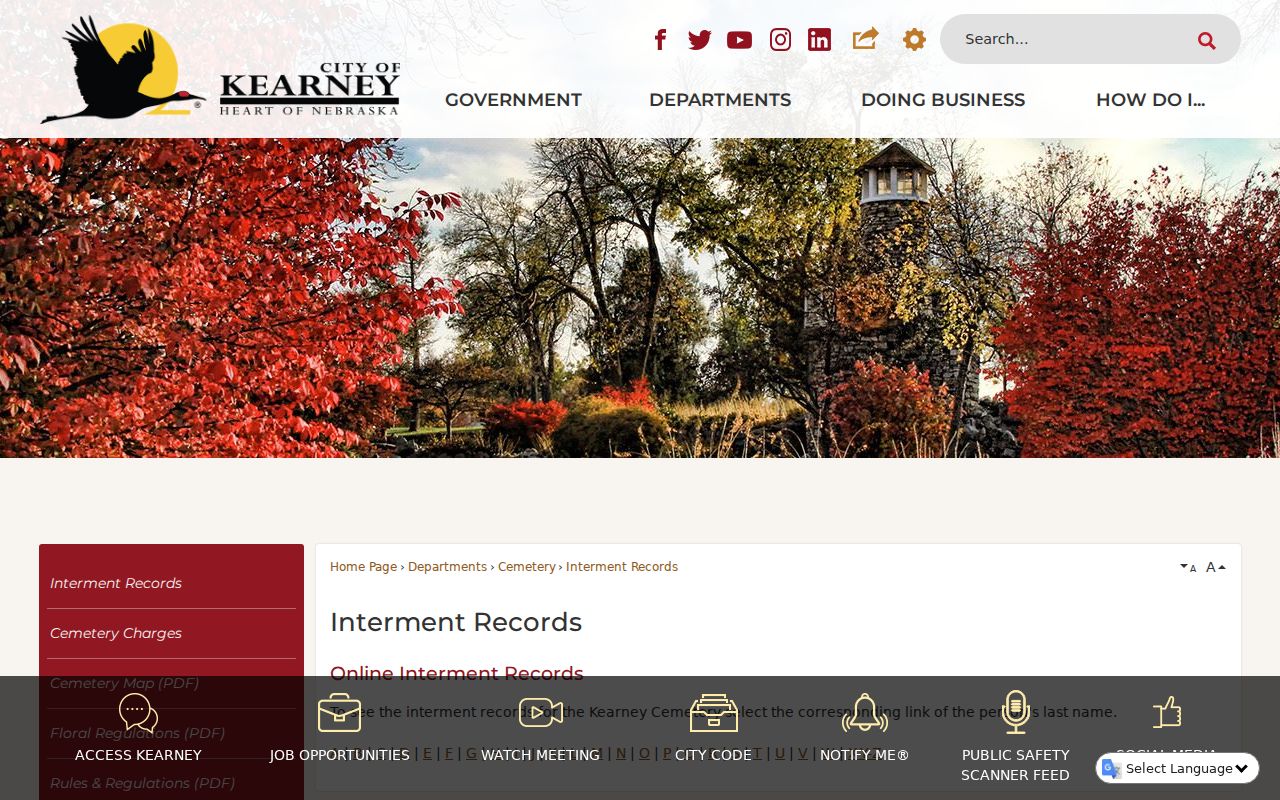
An interment result can be paired with the dated directory wording, then checked against a newspaper archive, marriage route, or archival finding aid without overclaiming what a single index proves.
For early Buffalo County context, the History Nebraska Buffalo County finding aid identifies court, clerk, assessor, and related archival series. It is a roadmap to holdings, not a complete name search.
Kearney Library Directory Access
Kearney Public Library gives the historical shelf a local access route. The library is at 2020 First Avenue, and its reference desk is listed at 308-233-3256. Its research resources include Kearney Hub historical material through NewsBank for cardholders, in-library Ancestry Library Edition, remotely available MyHeritage and HeritageHub for cardholders, and in-house FamilySearch Affiliate access. Each source has its own access boundary, so a directory lead should be carried to the source that can answer the next dated question.
The library’s online resources listing shows the local research channels available through the library.

The February 2026 FamilySearch Affiliate designation expanded in-house access to family-history images, while still leaving access methods different for remote, card-based, and in-library resources.
The library collection can add context to a household trail. It does not turn a historical directory listing into an official vital certificate or a present-day resident record.
Trace Kearney Directory Years
Trace one household through the directory years in order, keeping the original text alongside a normalized search note. The method starts with the first printed appearance and then looks for a move, a changed relationship mark, or a final appearance. A conclusion should be limited to what the records agree on. When a historical address is the main question, the modern address-keyed chain belongs with the Kearney by-street records.
- Find the surname in the earliest available volume and copy the printed name, page, address, and notation.
- Inspect every same-surname entry, then check the street section for the address and nearby numbers.
- Move to the next held year, recording changes rather than assuming a gap means a move.
- Pair directory dates with the nearest census year and a cemetery, newspaper, marriage, deed, or archival record that fits the question.
- Keep a source list with repository, year, page, and access date so another researcher can repeat the comparison.
A historical household trail often ends with an unresolved gap. That is a useful result when the missing year, repository, and next custodian are documented plainly. It avoids merging same-name people or treating a publisher’s snapshot as a complete record of a life.