
Kearney Previous Residents Sources
Older addresses leave different kinds of trails. Buffalo County's current land records can lead to a legal description and recorded instrument. The historical path then depends on the era: tax and assessor material can place a name in an earlier property context, a dated city directory can pair an address with household or business context, and archival records can fill gaps where no current portal reaches. The county does not publish a confirmed online start year for its deed index, so the counter, books, plat books, microfilm, and repository finding aids remain part of the Kearney previous residents process.
| Source | Years It Covers | Where Held | What It Shows |
|---|---|---|---|
| Land instruments | Online start year not located in official sources | Register of Deeds, courthouse computers, Laredo, or Tapestry EON | Parties, instrument date, document number, and legal description |
| Assessor and tax material | Assessor material 1870-1932; tax lists 1867-1911 | History Nebraska finding aid, archives, and current assessor files | Assessment, improvement, taxpayer, and property context |
| Kearney city directory | 1908-09 scanned; 1904-1933 microfilm and fragmented later runs located | NEGenWeb, library, microfilm, and institutional holdings | Dated address, household notation, occupation, and nearby listing context |
| Kearney Cemetery records | 1877-1995 | City index and History Nebraska microfilm finding aid | Interment, field, lot, and chronology clues |
| District Court records | 1871-1965 | Archive; later matters through Nebraska JUSTICE | Named events, dockets, judgments, and naturalization context |
| Sanborn and perspective maps | 1889 | Library of Congress | Street, block, addition, and building context |
Start with the source nearest the date in question. If the aim is an old household, the directory and archive route may be more useful than a present parcel view. If the aim is a tract's legal trail, begin with the current parcel and deed evidence, then move backward.
Kearney Address Date Marks
Before joining records, write down the printed address, the normalized modern form, the source date, and the source type. Kearney directories use forms such as Av G, Ave C, W 22d, and Central av. A modern tool may want Avenue G, Avenue C, West 22nd Street, or Central Avenue. Keeping both forms avoids silently turning a near match into an exact one.
Postal geography needs the same care. A postal result identifies delivery terminology, not the city boundary, parcel boundary, or a person's location. Use USPS for normalization, Kearney Smartmaps for city-side geography, and Beacon for parcel context. A deed return-to line, a county office mailing address, and a situs address each have a different role.
Kearney Deed Chain
For a Buffalo County address, the backward trail starts by matching the location to a parcel and legal description. Then use the Register of Deeds online-records information or the courthouse route to locate the most recent relevant instrument. Search parties on both sides of a transaction and inspect the image. A party can be a trust, estate, corporation, or former owner, so the recorded role and legal description matter more than a name alone.
- Normalize the address with USPS, check Smartmaps and Beacon, and record the parcel and legal description when available.
- Find the current owner's relevant purchase instrument through the Register's index, Laredo, Tapestry EON, or courthouse computer.
- Record the document number, date, parties, instrument type, legal description, return-to line, and linked references from the image.
- Search the seller as a grantee to locate that party's earlier acquisition, then repeat the process backward while comparing the legal description.
- When the online path stops, use office books, plat books, microfilm, staff assistance, and the History Nebraska finding aid rather than guessing an online cutoff.
- Grantor
- The party transferring or conveying an interest in an instrument. The role alone does not settle the full ownership history.
- Grantee
- The party receiving an interest in an instrument. Searching the grantee as a later grantor can help continue a chain backward.
- Chain of title
- A sequence of recorded interests connected through the same land description. One instrument is only one link in that sequence.
- Legal description
- The land description in the instrument, often using lots, blocks, sections, townships, ranges, or exceptions. It is more stable than an old street form.
Note: A deed can document a transaction or interest, but a complete title conclusion requires review of the whole chain and relevant exceptions.
Kearney Recorder Fallbacks
The Register of Deeds office is at 1512 Central Avenue and keeps permanent land records, including deeds, mortgages, deeds of trust, easements, subdivision plats, and other instruments. Courthouse computers, in-office copies, and plat books provide a counter route. Laredo offers a subscription view modeled on the courthouse workstation, while Tapestry EON is the one-off online option described by the county. The static county material does not state their exact coverage dates, field table, limits, or current prices.
Buffalo County also warns about a Recorded Deed Notice solicitation seeking $86. The office says courthouse copies cost $0.50 per page and offers Property Fraud Alert for future recording notifications after a person or business name and contact information are entered. Those notices help distinguish the official office from an unsolicited offer; they do not replace instrument review.
Kearney Directory Pairing
To locate past residents at one address, pair the alphabetical names section with the street section of the same directory. The 1908-09 R. L. Polk & Co. volume has alphabetical names on pages 27 through 136 and street listings on pages 137 through 156. The name section can add a relationship notation, occupation, printed residence, or business context. The street section can place several entries at one number. Record the exact wording and page before comparing a later volume, cemetery entry, newspaper item, or archival file.
The 1908 Kearney street-directory sample shows the address-oriented half of that comparison.
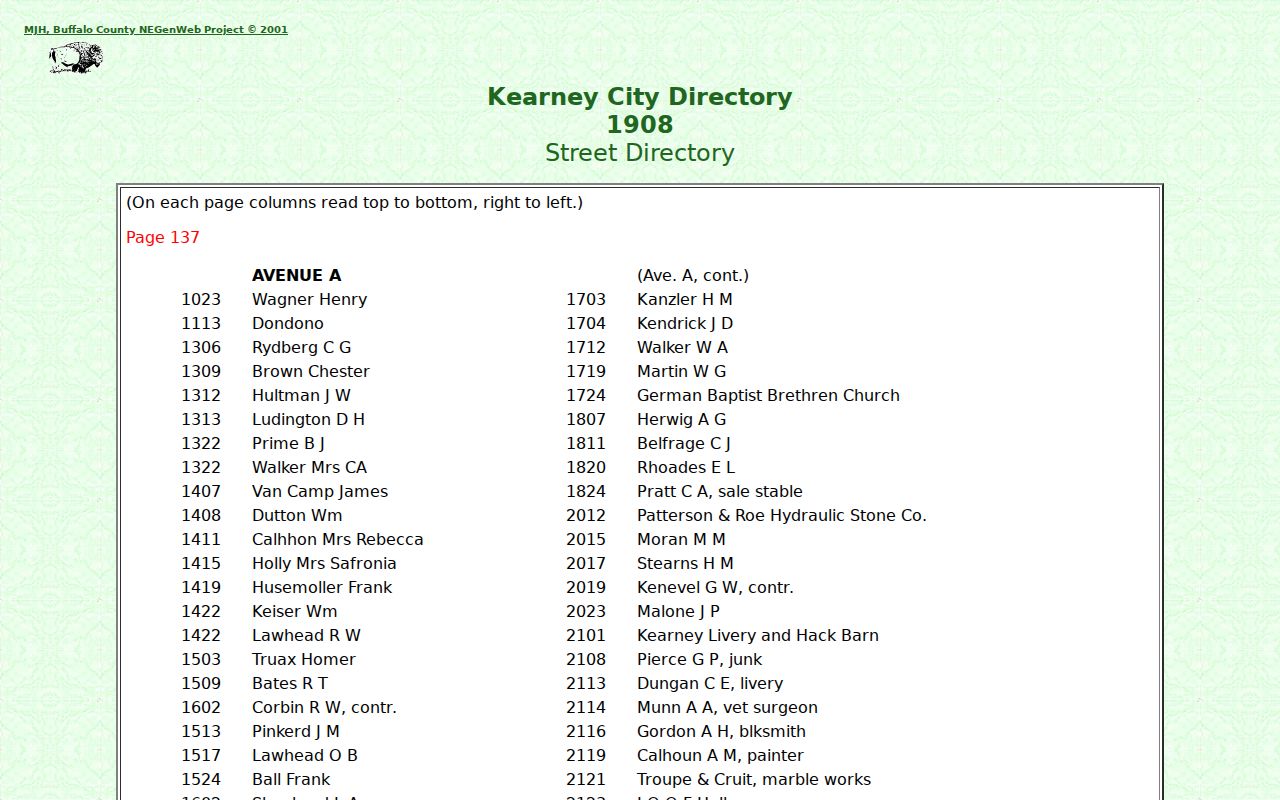
Read abbreviations carefully. Boards at may show a household relationship, and rooms same may connect a professional listing to the printed address. Neither term proves an uninterrupted residence. The full collection context is available through the Kearney city directories, while the immediate task is keeping the address, date, and printed entry together.
Use a simple household flow: directory year and original entry, then matching federal census year when available, followed by cemetery, marriage, obituary, or archive corroboration. Census and directory dates need not line up exactly, so identify the date gap rather than treating two entries as the same-day record.
Kearney Maps and Archives
Maps add street and block context to a past-resident trail. The 1889 Sanborn sheets are seven September 1889 sheets that show the built city, street orientation, and fire-insurance detail. The Library of Congress perspective map places West Kearney and East Lawn additions near the water-power canal and Platte River setting. These are historical geography records. They do not prove that a modern number, parcel, building, or household is unchanged.
The 1908 Kearney city-directory index provides the starting point for its printed volume.
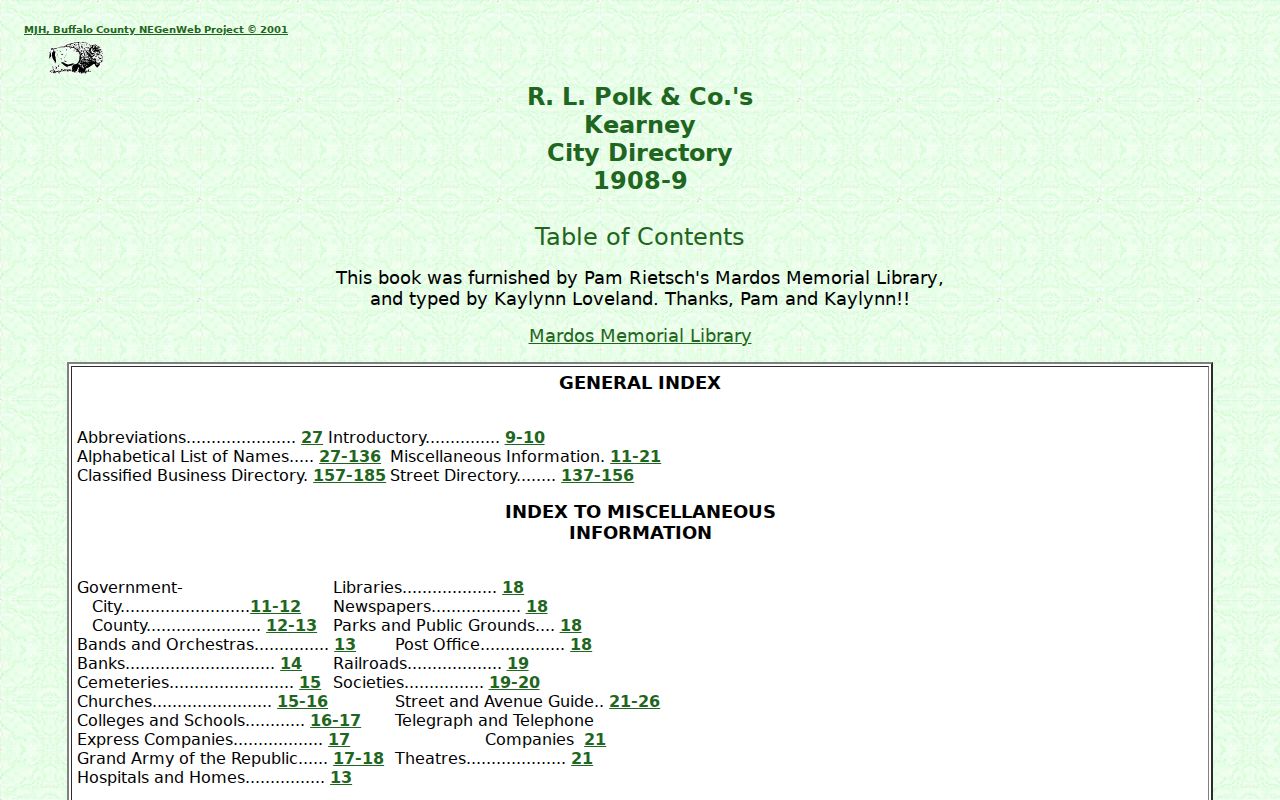
For deeper records, the History Nebraska Buffalo County finding aid maps assessor, treasurer, county board, clerk, court, and microfilm material. Kearney Public Library's reference desk and genealogy resources, along with the Buffalo County Historical Society archives, are practical routes when an index points to material that is not online.
Kearney Courthouse Record Gaps
Historical availability is uneven. The Buffalo County finding aid says early county records were largely destroyed around 1958, before the 1969 records-management program. A permanent courthouse was erected in 1886, but a record's age does not guarantee survival or online access. Later collections, microfilm, and Buffalo County Historical Society holdings compensate unevenly. Treat a gap as a reason to widen the repository search, not as evidence that a person or property had no earlier connection.
The archive lists assessor material from the 1870s, county board proceedings from 1870 through 1989, clerk marriage microfilm from 1872 through 1994, justice-of-peace dockets from 1873 through 1906, and district court material from 1871 through 1965. These date spans describe holdings, not complete name indexes. Record group, box, reel, page, creator, and date range make an archival reference usable later.
Kearney Cemetery Trail
Cemetery material can close part of a historical trail without proving an address. The City of Kearney maintains an alphabetical interment index, while the History Nebraska Kearney Cemetery finding aid describes records from 1877 through 1995 across seven microfilm reels with field, lot, and interment structures. Use the source date and location as family-history context, then compare it with a directory, deed, obituary, or vital-record route as appropriate.
Nebraska vital records have separate access rules. Marriage licenses are public, but certified vital copies require a proper purpose and qualifying relationship in many cases. A genealogy request becomes available when the registrant has been deceased at least 50 years. For a Kearney family question, the library's local resources, historical society, cemetery material, and the state route have different scopes.
Kearney City Record Requests
Some municipal records are held without a public search interface. A defined request can go to the City Clerk or the department that owns the record. City materials describe a signed request by email, fax, or mail and four-business-day response language for smaller requests, with copies or a deposit as applicable. State public-record rules require a specific record description and date range. State the address, type of record, and approximate period rather than making a broad person-name request.
The City Clerk, Building Services, Code Enforcement, Planning/Zoning, and Library each control different material. CitizenServe may require registration or login, and its exact public search fields and coverage were not captured. Ask the custodian what can be inspected and in which format.
Kearney Previous Residents Limits
A historical directory entry, archive finding-aid reference, interment record, or deed party is a lead, not identity proof. Compare same-name records with at least two independent details such as a date, middle initial, role, document number, family relationship, or legal description. Do not turn a historic address match into a claim about a living person's location. The Nebraska Address Confidentiality Program and voter-confidentiality rules protect qualifying people, and protected addresses must never be reconstructed from indirect records.
Nebraska Public Records Act access is broad unless another law excludes a record, but broad access does not remove privacy limits. Keep the record type, date, jurisdiction, source link, and critical limit next to each finding. That practice makes past residents research useful for family history, house history, and local history while reducing mistaken matches and unnecessary exposure.
Lawful use. Kearney previous residents research supports family and house history. Do not use historical or public records to stalk, harass, track, or expose any person.